
Introduction
When you work with the customers, suppliers, or partners in other countries, you have probably already come across terms like SWIFT, international cards, virtual accounts, or cross border payment platforms. Here's what usually causes the confusion "types of cross border payments" can actually mean two different things. First one is about who is paying whom and the other is about how the money physically moves. This guide walks through both, in plain language along with what Indian businesses specifically need to watch out for.
What Exactly Is a Cross Border Payment
A cross border payment is simply a transaction where the payer and the recipient are sitting in different countries. An Indian business receiving USD from an overseas client is both cross border and cross currency, but two parties in different countries could just as easily transact in the same currency, and it would still count as cross border.
This distinction matters because settlement can still require access to payment infrastructure in another country, even when no currency conversion is involved.
Why the Type of Payment Actually Matters
The relationship between who is sending money and who is receiving it, combined with the infrastructure used to move it, decides how that money gets collected, converted, settled, and reported. Get this wrong and you will end up choosing a payment setup that does not fit how your business actually operates.
Scale gives a sense of why this infrastructure matters so much. Global cross border bank claims reached around USD 46 trillion by the end of 2025, growing 11 percent over the year, according to the Bank for International Settlements. A SaaS company collecting hundreds of small monthly payments needs a very different setup from an exporter receiving one large invoice a few times a year, even though both are technically doing cross border business.
The Four Main Types of Cross Border Transactions
Cross border payments generally fall into four categories, based purely on who is on each end of the transaction: B2B, B2C, C2B, and C2C. Here is how they compare.
| Type | Sender | Recipient | Typical use case | Common methods |
|---|---|---|---|---|
| B2B | Business | Business | Export invoices, SaaS billing, supplier payments | Bank transfer, virtual account, platform |
| B2C | Business | Consumer | International payouts and refunds | Bank, wallet, platform |
| C2B | Consumer | Business | Ecommerce, travel, education payments | Card, wallet, gateway |
| C2C | Consumer | Consumer | Family transfers, personal remittances | Remittance network, bank, wallet |
What Is a B2B Cross Border Payment
This is a business paying another business across a border. An Indian software company invoicing a US client for USD 20,000, or an exporter getting paid by an overseas buyer, both fall here. These payments usually involve more attention to invoice accuracy, currency conversion, settlement timing, reconciliation, and the documentation your bank or tax advisor will eventually ask for.
What Is a B2C Cross Border Payment
This is a business paying a consumer abroad, such as an international payout or a refund. An Indian digital business selling a subscription to a customer in Europe is running a B2C flow in reverse. These payments tend to hinge more on customer experience: local payment preferences, how often payments actually go through, and how smoothly refunds are handled.
What Is a C2B Cross Border Payment
This is an individual paying a business in another country, like an Indian student paying tuition to a foreign university, or someone buying software from an overseas company. Cards, wallets, bank transfers, and local payment methods can all support this, depending on which country is involved and which provider is used.
What Is a C2C Cross Border Payment
This is money moving between two individuals across borders, such as sending funds to family overseas. It is worth keeping this separate from commercial export receipts, because the purpose of the transaction and the rules that apply to it can be quite different.
The Main Ways Cross Border Payments Actually Move
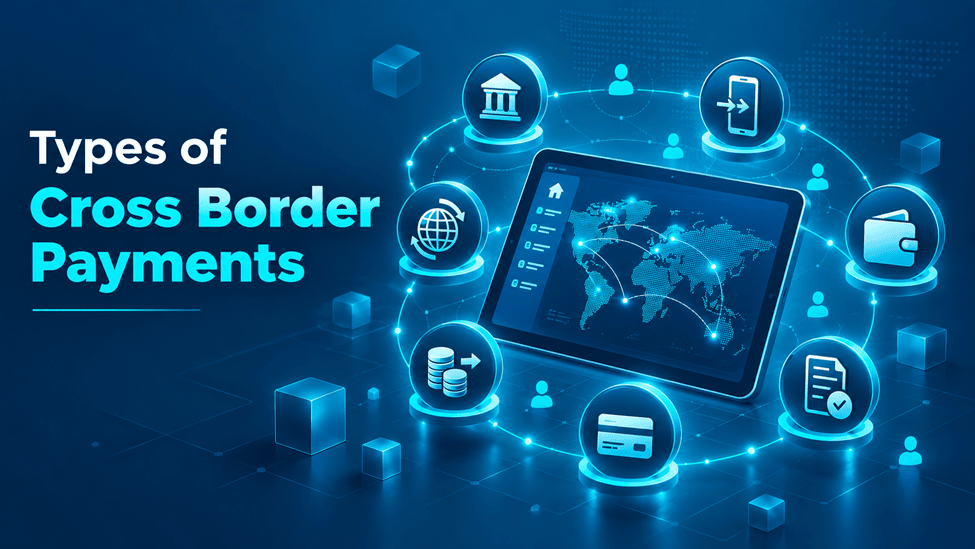
Separate from who is involved, there is the question of mechanism, meaning how the payment physically gets from one account to another. The common options are international bank transfers and SWIFT, card payments, digital wallets, local payment methods, payment gateways, cross border payment platforms, virtual or multi currency accounts, and remittance networks.
How Do International Bank Transfers Work
A bank transfer moves money between accounts in different countries, often through correspondent banking relationships and SWIFT messaging. Correspondent banks send instructions to debit or credit accounts, and a single payment can pass through more than one intermediary bank along the way. This is why an Indian business receiving USD from a US customer might see the payment take a slightly indirect route before it lands.
How Do Cross Border Card Payments Work
A card payment happens when a customer pays a merchant abroad using their card. This is common for ecommerce, subscriptions, travel, and digital services, largely because it feels familiar to the customer at checkout. What it actually costs depends on processing fees, the FX rate applied, and card network rules, not just the headline fee.
How Do Digital Wallets Work Across Borders
Wallets let customers pay or get paid without re-entering bank details every time. A customer may simply prefer a wallet they already use over typing out a full bank transfer. Which currencies are supported, how withdrawals work, and which country-specific rules apply can vary quite a bit by provider.
What Are Local Payment Methods
These are payment options that customers in a specific country already know and trust, whether that is a local bank transfer method or a domestic wallet. Offering these alongside international cards tends to reduce friction when you are selling into a new market.
SWIFT Transfer vs Cross Border Payment Platform: What Is the Difference
A SWIFT transfer is really just bank to bank messaging, the instructions that tell one bank to debit an account and another to credit it. A cross border payment platform does more: it can bundle payment collection, multiple payment methods, FX conversion, settlement, and reporting into one interface.
Modern infrastructure is moving toward more of this bundling. The BIS 2025 monitoring survey, covering 82 jurisdictions, flagged payment system interoperability, longer operating hours, the ISO 20022 messaging standard, and API frameworks as the areas seeing the most development.
Payment Type vs Payment Method: Why the Difference Matters
This is the distinction that trips people up most often. B2B tells you who is involved. SWIFT, or a card, or a platform, tells you how the money physically moved. They are not competing categories, they answer two different questions.
| Question being answered | Payment type | Payment method |
|---|---|---|
| What does it describe | Who is paying whom | How the money actually moves |
| Example | B2B, B2C, C2B, C2C | SWIFT transfer, card, wallet, platform |
| Why it matters | Shapes documentation and compliance needs | Shapes cost, speed and customer experience |
For example, an Indian company receiving USD 50,000 from an overseas business is a B2B payment. Whether that money arrives via a bank transfer or through an account based collection platform is simply the mechanism used, not a different type of transaction.
The Role of Payment Gateways and Cross Border Platforms
Gateways and platforms connect merchants and customers to payment methods, FX conversion, settlement, reporting, and compliance workflows, often in one place. In India, the RBI regulates entities that facilitate cross border payments for imports and exports under the Payment Aggregator Cross Border, or PA-CB, framework. RBI's October 2023 directions brought such entities directly under RBI regulation, so it is worth confirming that any platform you use actually holds this authorisation.
How Should Indian Businesses Actually Receive These Payments
Start by identifying what the payment actually represents: an export of goods, an export of services, an import, a marketplace transaction, or something else. That decides which channel and which documentation apply. An Indian SaaS company collecting recurring USD payments, for instance, might weigh a bank transfer against a virtual account or a regulated cross border platform, depending on its customer base and how it operates.
How FX and Currency Conversion Fit Into the Picture
FX, short for foreign exchange, is simply converting one currency into another when a payment needs it. An Indian exporter receiving USD but paying expenses in INR will run into an FX conversion at some point, and what that actually costs depends on the exchange rate used, the markup applied, transaction fees, and how settlement is structured.
This is not a purely theoretical concern either. The BIS reported that in April 2025, just over USD 5 trillion, or 36 percent of average daily FX settlement, went through payment versus payment mechanisms designed specifically to remove FX settlement risk.
What Cross Border Payments Actually Cost
Costs typically stack up from transaction fees, FX spreads or markups, intermediary charges, receiving bank fees, and other service charges layered on top of each other. The lowest advertised fee rarely tells the whole story. It is worth comparing the full cost of collection, conversion, settlement, reconciliation, and the possibility of refunds or chargebacks, rather than just the number printed on a homepage.
How Long Do These Payments Take to Settle
Settlement time depends on the payment method, the currencies involved, the banking relationships in play, operating hours, compliance checks, and how many institutions are involved along the way. A card payment might show as authorised to a customer almost instantly, while the actual merchant settlement follows on a separate timeline. A bank transfer may pass through one or more intermediaries before it reaches the beneficiary. The BIS also points out that the first and last stretch of many cross border payments still depends on domestic payment rails, which is part of why local infrastructure matters as much as the international leg.
Choosing the Right Setup for Your Business
There is no single correct answer here, only the setup that fits your specific transaction. A few things worth working through before picking a provider:
- Transaction type: is this B2B, B2C, C2B, or C2C
- Transaction value: small and frequent, or large and occasional
- Frequency: one-time, recurring, or high volume
- Geography and corridor: which countries are actually involved
- Currency: what needs to be collected, converted, or settled
- Customer preference: what your customers already use and trust
- Settlement: how fast, and into which account
- Total cost: fees, FX, and everything else stacked together
- Integration: do you need APIs, checkout tools, or dashboards
- Compliance: which RBI, FEMA, KYC, AML, and tax requirements apply
Working through these together, rather than picking a provider based on one attractive number, is what actually leads to a setup built around your real use case.
Where Cross Border Payments Are Headed
The next phase of this space is leaning heavily into interoperability, faster payment systems, standardised messaging, APIs, and broader access to payment infrastructure. The BIS itself notes that despite genuine progress on policy and infrastructure, actual improvements in cross border payment outcomes have been fairly modest so far.
For an Indian business, the practical next step is to map out each international payment flow before choosing a provider. Note the sender, the recipient, the purpose, the countries and currencies involved, expected volume, settlement needs, and the regulatory obligations that apply. Then compare providers on total cost, supported corridors, payment methods, FX handling, settlement speed, reporting, integration, and compliance support, in that order.
Conclusion
Cross border payments are not one single method, they are a mix of transaction relationships and payment infrastructure working together. B2B, B2C, C2B, and C2C describe who is paying whom, while bank transfers, cards, wallets, gateways, platforms, and virtual accounts describe how that payment actually moves.
Once this distinction is clear, evaluating international payment infrastructure gets a lot simpler. For Indian businesses, the right approach is matching the payment structure to the actual transaction: the corridor, the currency, the customer experience, the cost, the settlement requirements, and the regulatory framework that applies.